History of Newgrange
Newgrange, an ancient monument in Ireland, stands as a testament to the ingenuity of its early builders. This incredible site, older than both Stonehenge and the Egyptian pyramids, offers a fascinating look into the distant past. It’s a place steeped in mystery and wonder, and exploring the history of Newgrange really helps us understand a lot about the people who lived there long ago.
Key Takeaways
-
Newgrange was built by Stone Age farmers around 3200 BC, making it older than many other famous ancient structures.
-
The monument is known for its precise alignment with the winter solstice, where sunlight illuminates the inner chamber.
-
It’s part of the Brú na Bóinne complex, which includes other significant passage tombs like Knowth and Dowth.
-
Newgrange played a role in Irish mythology, often linked to ancient gods and revered as a sacred spot.
-
Modern archaeological work, especially by Michael O’Kelly, helped us understand how Newgrange was built and what its purpose might have been.
Ancient Origins and Construction
Neolithic Builders and Purpose
Newgrange, a monument of immense historical and cultural importance, was erected by Neolithic agriculturalists around 3,100 BC. These people, likely descended from a large Anatolian migration wave, cultivated crops and raised livestock in the area. The primary purpose of Newgrange remains a topic of debate, but it’s widely believed to have served as a passage tomb, a place of ritual significance, and a marker of astronomical events.
-
The monument’s construction predates Stonehenge and the Great Pyramid of Giza.
-
It highlights the sophisticated engineering skills of the Neolithic people.
-
The structure reflects a deep understanding of astronomy and its connection to their beliefs.
The construction of Newgrange represents a significant feat of engineering and social organisation. The movement and placement of massive stones, the precise astronomical alignments, and the intricate artwork all point to a society with advanced knowledge and a complex belief system.
Architectural Marvels and Materials
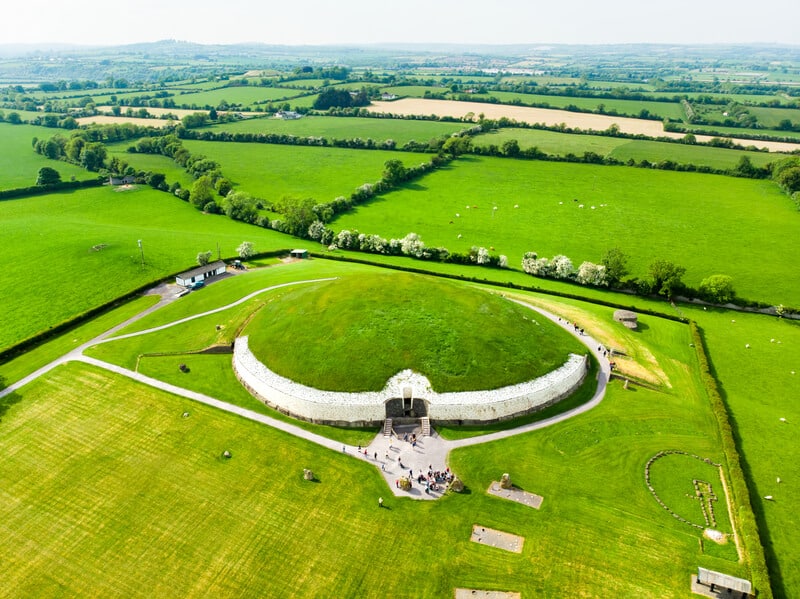
Newgrange is an architectural marvel, showcasing the ingenuity of its builders. The cairn, composed of thousands of pebbles weighing approximately 200,000 tonnes, was sourced from the nearby river terraces of the Boyne. The inner passage, chambers, and outer kerbstones consist of 547 slabs of greywacke, some transported from as far as 5 km away. This ancient construction is a testament to the builders’ resourcefulness and planning.
The Brú na Bóinne Complex
Newgrange is part of the Brú na Bóinne complex, a UNESCO World Heritage Site, which includes other significant passage tombs like Knowth and Dowth. This complex represents a concentration of prehistoric monuments, indicating the area’s importance in Neolithic society. The Brú na Bóinne complex showcases the rich archaeological landscape and the interconnectedness of these ancient sites. If you need to contact us, please do so.
-
Knowth is known for its extensive collection of megalithic art.
-
Dowth, while less excavated, holds significant archaeological potential.
-
The entire complex provides insights into the beliefs and practises of the Neolithic people.
It’s unfortunate that sometimes you get a 403 error when trying to access information online.
The Passage and Chamber
Inner Passage Dimensions
Okay, so the passage at Newgrange? It’s not exactly a stroll in the park, more like a crawl through history. The passageway itself stretches for just under 60 feet. Imagine creeping through that, knowing you’re heading into the heart of something ancient. The walls are made of these massive stone slabs, called orthostats, and they get a bit shorter as you go further in, because the passage slopes slightly upwards. It’s a tight squeeze, but it leads to something pretty special.
The Cruciform Chamber
At the end of the passage, you finally reach the chamber. It’s shaped like a cross, hence the name ‘cruciform’. There are three small recesses leading off a larger central area. The roof of this chamber is a corbelled vault, and it’s still intact and watertight after all these years, which is pretty amazing when you think about it. In each of the smaller chambers, there’s a large, flat stone basin. These basins are where they reckon the bones of the dead were placed way back when. Whether it was exclusively a burial site is still up for debate, but it definitely seems to have had some sort of ceremonial purpose.
Evidence of Burial Practises
Because the chamber was disturbed before any proper archaeological digs could happen, it’s hard to say exactly how many people were originally buried at Newgrange. They did find the remains of about five bodies inside, but there were probably more. Most of the bones had been cremated, with only a few bits left unburned. They also found beads made of bone, pendants, and polished stone balls. These contact information objects must have been important in the burial rituals. It’s possible that there were even more impressive things there originally, but they might have been taken without anyone recording them. New research suggests the solar observatories functioned as burial sites.
Astronomical Alignments
Winter Solstice Phenomenon
Okay, so Newgrange isn’t just a big pile of rocks; it’s a seriously clever bit of ancient engineering. The whole thing is aligned with the winter solstice, which is pretty mind-blowing when you think about it. Basically, on the shortest day of the year, the sun’s rays sneak through a roofbox right above the main entrance and light up the inner chamber. It’s like nature’s own light show, and it happens every year. Imagine the planning that went into that!
Precision of Ancient Engineering
It’s not just a rough alignment either; it’s incredibly precise. The sunlight hits the back wall of the chamber, illuminating the carvings inside. Apparently, back in the Neolithic period, the alignment would have been even more spot-on, hitting right at sunrise. The winter solstice alignment is way more accurate than similar setups at other passage graves. It makes you wonder how they managed to get it so right without all our fancy technology. It’s a testament to their knowledge of astronomy and engineering.
Symbolic Significance of the Solstice
So, why go to all that effort? Well, the winter solstice was a big deal for Neolithic people. It marked the turning point of the year, when the days started getting longer again. The illumination of the chamber at Newgrange could have been a symbolic way of celebrating this event, perhaps a ritual to encourage the return of the sun and ensure a good harvest. It’s all tied up with their beliefs about life, death, and the cycles of nature. The ancient Celts’ profound knowledge is really impressive.
It’s easy to imagine the excitement and anticipation as the sun’s rays slowly creep into the chamber, lighting up the ancient carvings. This event would have been a powerful reminder of the sun’s life-giving power and the promise of renewal.
Here are some possible interpretations:
-
A celebration of the sun’s return.
-
A ritual to ensure a good harvest.
-
A symbolic representation of life and death.
Mythology and Folklore
Newgrange in Celtic Lore
Newgrange, or Síd in Broga as it’s often known in Irish mythology, is more than just an ancient monument; it’s a doorway to the Otherworld. It’s seen as a dwelling place for the Tuatha Dé Danann, those mythical figures from Irish legend. It’s pretty wild to think that this structure, built thousands of years ago, is so deeply woven into the fabric of Irish storytelling. It’s not just a pile of stones; it’s a portal to another dimension, at least according to the old tales. Understanding Irish culture is key to understanding the significance of Newgrange.
The Dagda Mor and Aongus
One of the most famous stories linked to Newgrange involves the Dagda Mor, a powerful god, and his son Aongus. Aongus, through trickery, manages to claim Brú na Bóinne (Newgrange) as his own. This tale highlights the importance of Newgrange as a place of power and prestige in the mythological landscape. The story goes that Aongus only asked to own it for a day and a night, but because the Irish defined a day and night as a full cycle, he ended up owning it forever. It’s a clever story that shows how important words and their interpretation were, even back then. It’s a reminder that sometimes, the smallest details can have the biggest consequences.
Local Traditions and Beliefs
Even today, Newgrange holds a special place in the hearts and minds of locals. There are stories passed down through generations, beliefs about the powers that reside within the ancient mound. Some say it’s a place of healing, others believe it’s a place where the veil between worlds is thin. These traditions, while not always historically accurate, add another layer to the mystique of Newgrange. It’s a living monument, not just in stone, but in the ongoing stories and beliefs of the people who live nearby. You can contact us for more information.
It’s fascinating how a place can hold so much history and mythology at the same time. Newgrange isn’t just an archaeological site; it’s a cultural touchstone, a place where the past and present intertwine. It’s a reminder that stories are just as important as stones when it comes to understanding our heritage.
Later Historical Periods
The Beaker People’s Influence
After the main phase of Newgrange’s construction and use, around the late Neolithic period, other cultures left their mark on the landscape. The Beaker people, known for their distinctive pottery, arrived in Ireland. While they didn’t drastically alter Newgrange itself, evidence suggests they interacted with the site. Their presence is mainly indicated by the discovery of Beaker pottery shards in and around the monument. This suggests a continued, though perhaps different, relationship with the site. It’s not clear if they understood the original purpose, but they were certainly aware of its existence. The Beaker culture’s influence is a reminder that Newgrange existed within a changing cultural landscape. You can contact All Things SEO for more information.
The Enigmatic Stone Circle
Around the main mound of Newgrange lies a circle of standing stones. These stones weren’t part of the original construction. They were added later, possibly during the Bronze Age. The purpose of this stone circle remains something of a mystery. It could have been used for rituals, ceremonies, or simply as a way to mark the area. The stones themselves are quite large, and their placement suggests a deliberate design. It’s possible that the stone circle represents a shift in belief systems or a change in how the site was used. The physical address is available on the website.
Transition to Disuse
Eventually, Newgrange fell out of regular use. The reasons for this are unclear, but it’s likely a combination of factors. Changes in climate, shifts in population, and the rise of new religious beliefs could all have played a role. Over time, the monument became overgrown and its original purpose was forgotten. Local folklore likely kept some memory of the site alive, but its significance was largely lost. It became just another mound in the landscape, waiting to be rediscovered. Here are some possible reasons for the transition to disuse:
-
Climatic changes impacting agriculture and settlement patterns.
-
Emergence of new social and religious structures.
-
Loss of knowledge regarding the monument’s original function.
The transition to disuse wasn’t a sudden event. It was a gradual process spanning centuries. The monument slowly faded from active use, becoming a relic of a distant past. The phone number is available if you need to reach out.
Early Discoveries and Study
Seventeenth-Century Antiquarian Interest
So, Newgrange basically sat there, looking like a big grassy hill, for ages. Then, in the 17th century, things started to happen. See, the land it was on belonged to a guy called Charles Campbell. He wanted some stone, so he told his workers to dig into the mound. Can you imagine? They accidentally stumbled upon the entrance to the tomb! A Welsh antiquarian named Edward Lhwyd was knocking about nearby and got super interested. He wrote about it, calling the carvings “barbarous” – charming, right? He also mentioned finding animal bones, beads, and bits of glass. Turns out, those “glass” bits were probably polished pottery beads, which were common in Neolithic tombs. Another antiquarian, Sir Thomas Molyneux from Trinity College Dublin, popped by too. Campbell told him they’d found two bodies in there. It’s wild to think how casually they just dug into this ancient site!
Initial Archaeological Investigations
After the initial discovery, Newgrange became a bit of a tourist spot for antiquarians. People like William Wilde, Thomas Pownall, and others all came to have a gander and write about it. They measured things, sketched things, and generally tried to figure out what it all meant. The problem was, they didn’t really have the archaeological methods we have today. Thomas Pownall did a pretty detailed survey in 1769, numbering all the stones and recording some of the carvings. He had his own ideas about what the mound was for, but a lot of those ideas have been proven wrong since. It’s interesting to see how people interpreted the site with the limited knowledge they had back then. In 1786, Charles Vallancey analysed the engravings on the stones, interpreting them as evidence of a “Mithratic cave”.
The Role of Caretakers
I don’t know much about the caretakers, but I imagine they played a crucial role in protecting the site from further damage and keeping it safe for visitors. They were the first line of defence against looters and vandals, and they also helped to preserve the site for future generations. They probably had a deep understanding of the site and its history, and they were able to share that knowledge with visitors. They were the unsung heroes of Newgrange, and they deserve our gratitude.
It’s easy to forget that before modern archaeology, people were just guessing about these sites. They didn’t have carbon dating or DNA analysis or any of the fancy tools we use now. So, while their theories might seem a bit silly today, they were doing their best with what they had. And, in a way, their curiosity helped to keep Newgrange alive in the public imagination.
Modern Archaeological Excavations
Michael O’Kelly’s Extensive Work
Professor Michael J. O’Kelly’s work at Newgrange, starting in 1962, was a game-changer. Before him, there had been bits and pieces of investigation, but O’Kelly’s team really dug in (literally!). His excavations were incredibly thorough, and they revealed so much about the structure and its history. It wasn’t just about finding things; it was about understanding context. They meticulously recorded everything, from the position of each stone to the layers of soil. O’Kelly’s detailed reports and publications are still the foundation for much of what we know about Newgrange today. He really set the standard for future archaeological work at the site.
Reconstruction of the Monument
One of the most visible aspects of O’Kelly’s work was the reconstruction of the front of Newgrange. The white quartz facade and the ‘roof box’ above the entrance are largely the result of his interpretation and reconstruction efforts. This reconstruction wasn’t without its critics, some arguing that it was too speculative and that it altered the original character of the monument. However, O’Kelly argued that it was necessary to protect the structure and to give visitors a better sense of what it might have looked like originally. It’s still a topic of debate among archaeologists, but it undeniably made Newgrange a more accessible and understandable site for the public. You can contact an SEO expert if you want to learn more about the topic.
Understanding Newgrange’s Function
O’Kelly’s excavations also shed light on the possible function of Newgrange. While the exact purpose remains a mystery, his work strongly suggested a connection to the winter solstice. The way the sunlight penetrates the passage and illuminates the chamber on the shortest day of the year is pretty amazing. O’Kelly’s team also found evidence of burials and ritual activity, suggesting that Newgrange was more than just a tomb; it was a place of ceremony and possibly spiritual significance. The lack of human remains makes it difficult to know for sure.
It’s important to remember that archaeology is an ongoing process. New discoveries and new interpretations are constantly changing our understanding of sites like Newgrange. What we think we know today might be challenged by new evidence tomorrow. That’s part of what makes it so fascinating.
Here are some key aspects of understanding Newgrange’s function:
-
Alignment with the winter solstice
-
Evidence of burial practises
-
Possible ritual significance
New DNA analysis could reveal more about the people who built it.
Modern digs help us learn so much about the past. If you’re keen to find out more about how we uncover history, pop over to our website. You’ll find loads of cool stuff there!
Conclusion
So, Newgrange, right? It’s more than just a pile of old stones. It’s a real head-scratcher, showing us how clever people were way back when. Think about it: they built this huge thing, and it still lines up perfectly with the sun on the shortest day of the year. That’s just wild. It makes you wonder what they were thinking, what they believed in. It’s a place that really connects us to the past, reminding us that even thousands of years ago, people were doing amazing stuff. It’s a proper piece of history, just sitting there, waiting for us to come and be amazed.
Frequently Asked Questions
What is Newgrange?
Newgrange is a very old monument, like a big mound of earth and stones, built by people who lived in the Stone Age. It’s found in Ireland and is famous for a special event that happens there every winter.
How old is Newgrange?
Newgrange was built around 3200 BC, which means it’s about 5,200 years old. That makes it even older than famous places like Stonehenge in England and the Great Pyramids of Egypt!
Who built Newgrange and why?
It’s thought that Newgrange was built by ancient farmers. They were very clever and organised, working together to create this huge structure. It was likely a special place for ceremonies and perhaps even a burial site.
Is Newgrange a World Heritage Site?
Yes, it is! Newgrange is part of a bigger area called Brú na Bóinne, which also includes other ancient sites like Knowth and Dowth. Because of its importance, UNESCO has made it a World Heritage Site, meaning it’s a special place for everyone to protect.
What happens at Newgrange during the winter solstice?
Newgrange is famous for its alignment with the winter solstice. On the shortest day of the year, the rising sun shines directly through a special opening above the entrance, lighting up the main chamber inside. It’s a truly amazing sight!
How can I visit Newgrange?
You can only visit Newgrange by taking a guided tour from the Brú na Bóinne Visitor Centre. From there, you’ll cross the river and take a shuttle bus to the monument itself.
For more info on tours of the Boyne Valley region click here or indeed get in touch with us on info@ancienteasttourcompany.ie