Knowth: Companion Tomb
Alright, so you’ve probably heard about Newgrange, right? It’s that super old tomb in Ireland. But there’s another amazing spot nearby called Knowth, and honestly, it’s just as cool, maybe even cooler in some ways. It’s part of the whole Brú na Bóinne area, which is packed with ancient history. Think of this as your friendly guide to everything Knowth – what makes it special, how it lines up with the stars, and why it’s such a big deal for understanding people who lived thousands of years ago.
Key Takeaways
- Knowth is a Neolithic passage tomb, similar to Newgrange but with its own unique features.
- It has two passages and a central chamber, and it’s older than Newgrange.
- The tomb shows amazing astronomical alignments, especially with the spring and autumn equinoxes.
- Knowth is part of the Brú na Bóinne UNESCO World Heritage Site, which also includes Dowth.
- People think Knowth was a burial place for important figures and possibly had other ceremonial uses.
Exploring Knowth’s Ancient Design
Knowth, part of the Brú na Bóinne complex, is a fascinating site. It’s not just one thing; it’s a collection of features that show the ingenuity of Neolithic people. It’s older than Newgrange, and it has a unique layout and a tonne of inscribed stones. Let’s take a look at what makes Knowth so special.
Twin Passages and Central Chamber
Unlike Newgrange, Knowth boasts two passage tombs within its main mound. These passages, one eastern and one western, lead to separate inner chambers. This dual structure is pretty rare and suggests that Knowth might have had a more complex purpose than just a simple burial site. The eastern tomb contains three signs carved on the backstone of the northern recess, a unique motif found nowhere else in the complex. It’s thought that the chambers may have been used to bury significant figures, possibly priests.
Lavishly Decorated Kerbstones
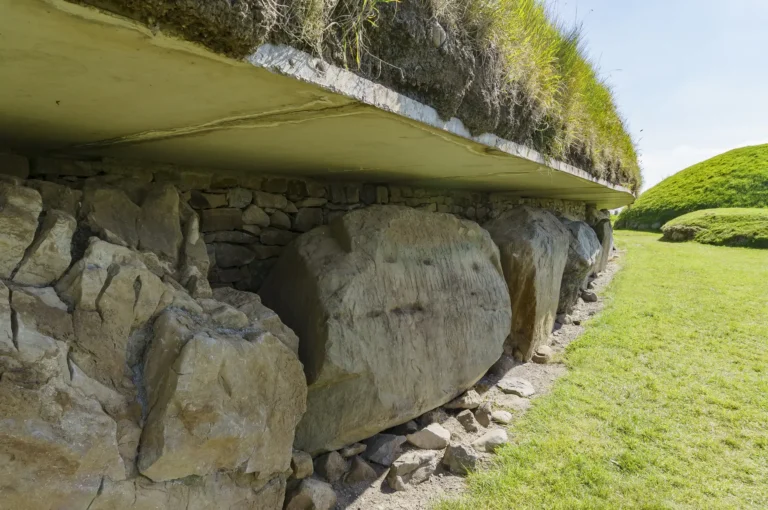
One of the most striking things about Knowth is the sheer number of decorated kerbstones. These stones, which surround the base of the mound, are covered in Neolithic art. We’re talking spirals, zigzags, and all sorts of abstract shapes. The kerbstones are not just decorative; they might have had some symbolic meaning. It’s like they were trying to tell us something, but we’re not quite sure what. Admire the decorated kerbstones at Knowth; they are truly impressive.
Satellite Mounds Surrounding Knowth
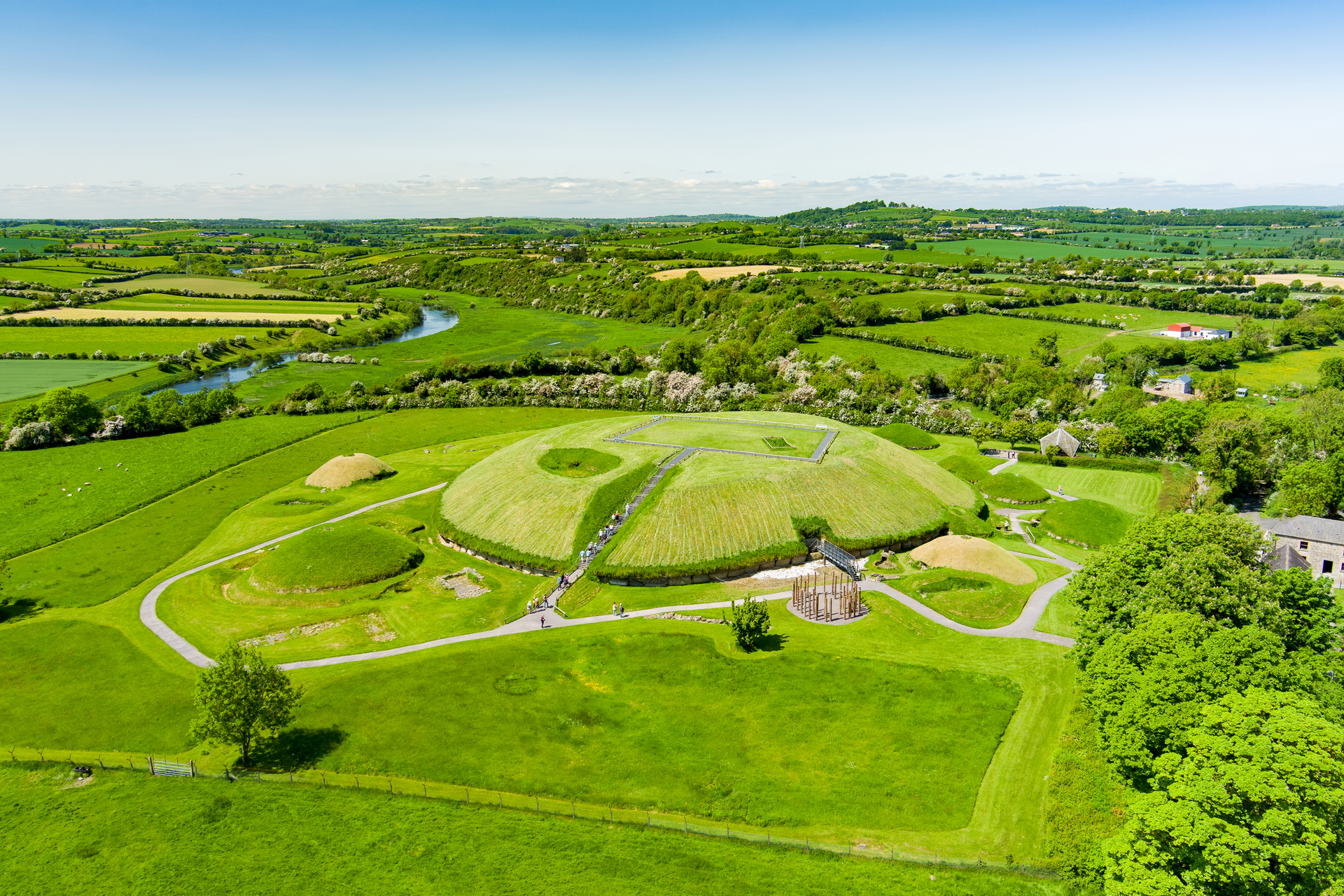
Knowth isn’t just the main mound; it’s surrounded by a bunch of smaller mounds, called satellite mounds. There are about 18 of these, and they vary in size and structure. Some of them are passage tombs themselves, while others might have been used for different purposes. These satellite mounds add another layer of complexity to the site and show that Knowth was a central hub in a larger landscape. The tumulus features a circular stone wall that acts as an internal delimitation, retaining a central cairn within the megalithic tomb.
It’s easy to see Knowth as just a pile of rocks, but it’s so much more than that. It’s a testament to the skill and knowledge of the people who built it. They were able to create a structure that has lasted for thousands of years, and that continues to fascinate us today.
Knowth’s Astronomical Alignments
Knowth, much like its more famous neighbour Newgrange, seems to have been built with the heavens in mind. While Newgrange is renowned for its winter solstice alignment, Knowth’s story is a bit more complex, and perhaps even more intriguing. There’s a growing body of evidence suggesting that the builders of Knowth possessed a sophisticated understanding of astronomy, and that this knowledge was incorporated into the very design of the monument.
Equinox Sunrise and Sunset Phenomena
One of the most interesting theories about Knowth is that its two passages, which run back-to-back, were designed to align with the sun during the spring and autumn equinoxes. This would mean that, twice a year, the rising and setting sun would cast its rays down these passages, illuminating the inner chambers. While this theory, championed by researchers like Martin Brennan, has faced some scepticism, it’s gaining traction as more evidence comes to light. It’s a fascinating idea to think that the ancient people of Knowth were marking these important celestial events with such precision.
Lunar Maps on Inscribed Stones
Beyond the solar alignments, there’s also the possibility that some of the inscribed stones at Knowth depict lunar maps. This is a pretty mind-blowing concept, suggesting that these ancient people were not only observing the moon, but also recording its features and movements. Philip Stooke has done some fascinating work on this, arguing that these inscriptions could be the oldest known lunar maps. Imagine, mapping the moon on stone thousands of years ago!
Kerbstone 15 as a Potential Sundial
Then there’s Kerbstone 15. Some researchers believe that this particular stone may have functioned as a sundial. The idea is that the shadows cast by the sun would have marked the passage of time, or perhaps even specific dates in the year. It’s a compelling thought, and it highlights the potential for Knowth to have been more than just a tomb; it could have been a kind of astronomical observatory. It’s important to note that while these theories are exciting, they also require rigorous testing and further investigation. The winter solstice alignment at Newgrange is well-established, but Knowth’s astronomical secrets are still being uncovered.
It’s easy to dismiss these ideas as speculation, but we need to remember that the people who built Knowth were incredibly intelligent and observant. They lived in a world where the movements of the sun, moon, and stars were deeply connected to their daily lives. It’s not unreasonable to think that they would have incorporated this knowledge into their monuments.
Knowth’s Historical Significance
Older Than Newgrange
While both Knowth and Newgrange share similarities in construction, Knowth is actually the older of the two. Dating back approximately 5,200 years, it predates the Egyptian pyramids and stands as a testament to the ingenuity of Neolithic people. This age difference provides valuable insight into the evolution of passage tomb construction and the cultural practises of the time. The archaeological record suggests a continuous period of activity at Knowth, spanning several centuries, making it a crucial site for understanding the broader Brú na Bóinne complex.
Burial Site for Significant Figures
Knowth is thought to have served as a burial site, potentially for individuals of high status within the community. While the exact identities of those interred remain unknown, the complexity of the tomb and the richness of its decoration suggest they were significant figures. It’s speculated that these could have been priests, chieftains, or other individuals holding important roles in Neolithic society. The presence of multiple chambers and the sheer scale of the monument indicate a deliberate effort to create a lasting memorial for these individuals. The Knowth Neolithic passage tomb is a testament to their importance.
Part of Brú na Bóinne UNESCO Site
Knowth is an integral part of the Brú na Bóinne UNESCO World Heritage Site, a landscape rich in prehistoric monuments. This designation recognises the outstanding universal value of the site and its importance for understanding Neolithic culture. Brú na Bóinne encompasses not only Knowth and Newgrange but also Dowth and numerous other smaller sites, creating a complex and interconnected landscape of ritual and burial monuments. Being part of this UNESCO site ensures the preservation and protection of Knowth for future generations. The contact information for the visitor centre is readily available.
The inclusion of Knowth within Brú na Bóinne highlights its significance within a broader cultural and historical context. The site offers a unique window into the beliefs, practises, and social structures of Neolithic society, providing invaluable insights into the lives of our ancestors.
Here are some key aspects of Knowth’s significance:
- Its age and complexity provide insights into the evolution of passage tomb construction.
- The rich decoration and multiple chambers suggest the burial of significant individuals.
- Its inclusion in the Brú na Bóinne UNESCO site underscores its outstanding universal value.
Visiting Knowth Today
Access Through the Visitor Centre
Planning a trip to Knowth? Well, you can’t just rock up and wander around. Access to Knowth is only possible via the Brú na Bóinne Visitor Centre, which acts as the gateway to both Knowth and Newgrange. You’ll need to book a tour, and these often fill up quickly, especially during peak season. The tour usually involves a shuttle bus to the site, as it’s a bit of a distance from the centre itself. It’s all very organised, but definitely book in advance to avoid disappointment. You can start your journey in the Boyne Valley at the visitor centre.
Virtual Experiences for Conservation
Because Knowth is so old and delicate, there are limits to how many people can visit the actual site each day. To help preserve it, and to give more people a chance to ‘see’ it, there are virtual experiences available. These use technology to create a realistic tour of the tomb, letting you explore the chambers and see the ancient carvings without physically being there. It’s a great option if you can’t make it to Ireland, or if the tours are fully booked. Plus, it helps protect the monument for future generations.
Understanding Neolithic Life
Visiting Knowth isn’t just about seeing an old tomb; it’s about stepping back in time and trying to understand how people lived thousands of years ago. The visitor centre has exhibitions that show what life was like in Neolithic Ireland. You can see:
- Reconstructions of houses
- Examples of tools and pottery
- Explanations of farming techniques
It really brings the whole site to life and helps you appreciate the skill and ingenuity of the people who built Knowth. You can learn about how they treated their dead, before hopping on a shuttle bus to see the real thing.
It’s easy to forget, wandering around the site, that this was once a thriving community. The exhibitions help you connect with the people who lived and died there, making the whole experience much more meaningful.
Comparing Knowth and Newgrange
Similarities in Construction
Both Knowth and Newgrange are impressive megalithic structures sharing fundamental construction techniques. They both consist of large mounds built from stone and earth, surrounded by kerbstones. The use of white quartz in the facade is another shared characteristic, although more prominent at Newgrange. Both sites also feature internal passages leading to chambers, indicating a similar architectural approach to creating these passage tombs. It’s clear that the builders of both monuments possessed a sophisticated understanding of engineering and construction, allowing them to create structures that have stood for thousands of years.
Differences in Internal Chambers
While sharing construction similarities, Knowth and Newgrange differ significantly in their internal layouts. Newgrange features a single, cruciform-shaped chamber, whereas Knowth boasts two separate passages leading to distinct inner chambers. This difference suggests potentially different uses or symbolic meanings for each site. The presence of two chambers at Knowth might indicate a more complex ritualistic purpose or perhaps the burial of multiple individuals. The Newgrange-style tombs are architecturally complex.
Variations in Inscribed Stones
One of the most striking differences between Knowth and Newgrange lies in the quantity and style of their inscribed stones. Knowth contains a far greater number of decorated kerbstones and internal stones compared to Newgrange. In fact, Knowth holds approximately one-quarter of all known megalithic art in Europe. The motifs and patterns found on these stones vary, with some researchers suggesting they represent astronomical charts, maps, or symbolic representations of the cosmos. The sheer abundance of these carvings at Knowth suggests a greater emphasis on artistic expression or record-keeping compared to Newgrange. For an optimal Neolithic experience, visit both Newgrange and Knowth.
It’s important to remember that while we can observe these differences in construction, internal chambers, and inscribed stones, the exact reasons for these variations remain a subject of ongoing research and debate. Understanding these nuances helps us appreciate the unique character of each monument and the complexity of Neolithic society.
The Broader Brú na Bóinne Landscape
Dowth Passage Tomb’s Features
Dowth, often overshadowed by Newgrange and Knowth, is another significant passage tomb within the Brú na Bóinne complex. It’s a bit of a hidden gem, really. Unlike the others, you can actually drive right up to it, which is handy. Dowth has two burial chambers and some interesting prehistoric drawings.
- Features a ritual basin.
- Has an early Christian souterrain.
- Known as the ‘fairy mound of darkness‘.
The tomb suffered damage during an excavation back in 1847, so you can’t go inside. But honestly, just wandering around the site gives you a real sense of its history. It’s a much quieter experience than Newgrange, which can be a nice change.
The Brú na Bóinne Visitor Centre
If you’re planning a trip to Brú na Bóinne, the visitor centre is the place to start. It’s not just a place to buy tickets; it’s a proper introduction to the whole area. The centre has a full-scale replica of the Newgrange chamber, which is pretty impressive. You can also see a model of one of the smaller tombs at Knowth. It’s a great way to get your bearings and understand the significance of what you’re about to see.
The Hill of Tara’s Historical Context
The Hill of Tara, while not technically part of the Brú na Bóinne complex, is closely linked to its history and importance. It’s only a short drive away, and well worth a visit. It was once the seat of the High Kings of Ireland, and you can feel the history as you walk around. It’s a place steeped in legend and tradition. The archaeological research solar observatories is fascinating.
Here’s a quick comparison of the sites:
| Site | Key Feature |
|---|---|
| Newgrange | Winter solstice alignment |
| Knowth | Extensive collection of megalithic art |
| Dowth | Damaged but atmospheric, less crowded |
| Hill of Tara | Seat of the High Kings of Ireland |
Archaeological Interpretations of Knowth
Beyond the ‘Passage-Grave’ Description
For a long time, Knowth, like Newgrange, was mainly seen as just a fancy passage grave. But, that view is changing. More people are starting to think there’s more to it than just a burial site. It’s like assuming a smartphone is only good for making calls – you’re missing out on a lot of potential. The traditional description might be too simple.
Theories on Symbolic Meanings
What do all those carvings actually mean? Are they just random doodles, or do they tell a story? Some think they’re maps of the moon, others believe they’re connected to ancient calendars. It’s a bit like trying to read a language we’ve completely forgotten. The possibilities are pretty interesting:
- Astronomical charts.
- Ritualistic symbols.
- Records of important events.
It’s important to remember that our interpretations are based on what we know now. The people who built Knowth had a completely different worldview, so we need to be careful about projecting our own ideas onto their creations.
Modern Research and Technology
New tech is helping us understand Knowth in ways that weren’t possible before. Computer simulations can show how sunlight enters the chambers at different times of the year, and new surveying methods can reveal hidden details. It’s like giving archaeologists a new set of eyes. Plus, some researchers are looking at the ideas of people like Martin Brennan, who thought some stones might be sundials. It’s all about testing those ideas properly. New research offers a fresh interpretation of the megalithic art. It’s a slow process, but we’re gradually piecing together the puzzle.
The ancient site of Knowth has many secrets, and experts have different ideas about what it all means. From old burial customs to how people lived long ago, each new find helps us learn more. Want to dig deeper into these amazing discoveries and see what else we’ve uncovered?
Wrapping Up Our Knowth Journey
So, there you have it. Knowth isn’t just some old pile of rocks; it’s a really special place, full of history and mystery. It reminds us how clever people were way back when, building these amazing structures that still stand today. Even though it’s not as famous as Newgrange, Knowth definitely holds its own with those cool carvings and the way it lines up with the sun. Visiting places like this really makes you think about the past and how much there still is to learn. It’s a proper piece of Ireland’s story, and well worth a look if you’re ever in the area.
Frequently Asked Questions
What exactly is Knowth?
Knowth is an ancient burial mound in Ireland, part of the Brú na Bóinne complex. It’s a huge stone structure with two long passages leading to a central room. It’s famous for its many decorated stones, which show old carvings and symbols.
How old is Knowth?
Knowth is even older than Newgrange, another famous site nearby. It was built around 3,200 BC, meaning it’s over 5,000 years old. That makes it older than the pyramids in Egypt!
What are the special sun alignments at Knowth?
Knowth has two main passages that point towards the sunrise and sunset during the spring and autumn equinoxes. This means that on those special days, the sun’s rays shine right into the tomb. This shows how clever the ancient builders were with their understanding of the sky.
Can I visit Knowth today?
Yes, you can visit Knowth! You usually start at the Brú na Bóinne Visitor Centre, which is the main place for tours of the ancient sites in the area. From there, you can take a bus to Knowth itself.
How is Knowth different from Newgrange?
Knowth is similar to Newgrange in that both are large stone mounds with passages. However, Knowth has two passages and a central chamber, while Newgrange has one. Knowth also has many more decorated stones with unique carvings.
What other sites are near Knowth?
Knowth is part of the Brú na Bóinne UNESCO World Heritage Site. This area also includes Newgrange and Dowth, along with many smaller ancient sites. It’s a very important historical landscape in Ireland.
For more info on tours of the Boyne Valley region click here or indeed get in touch with us on info@ancienteasttourcompany.ie